
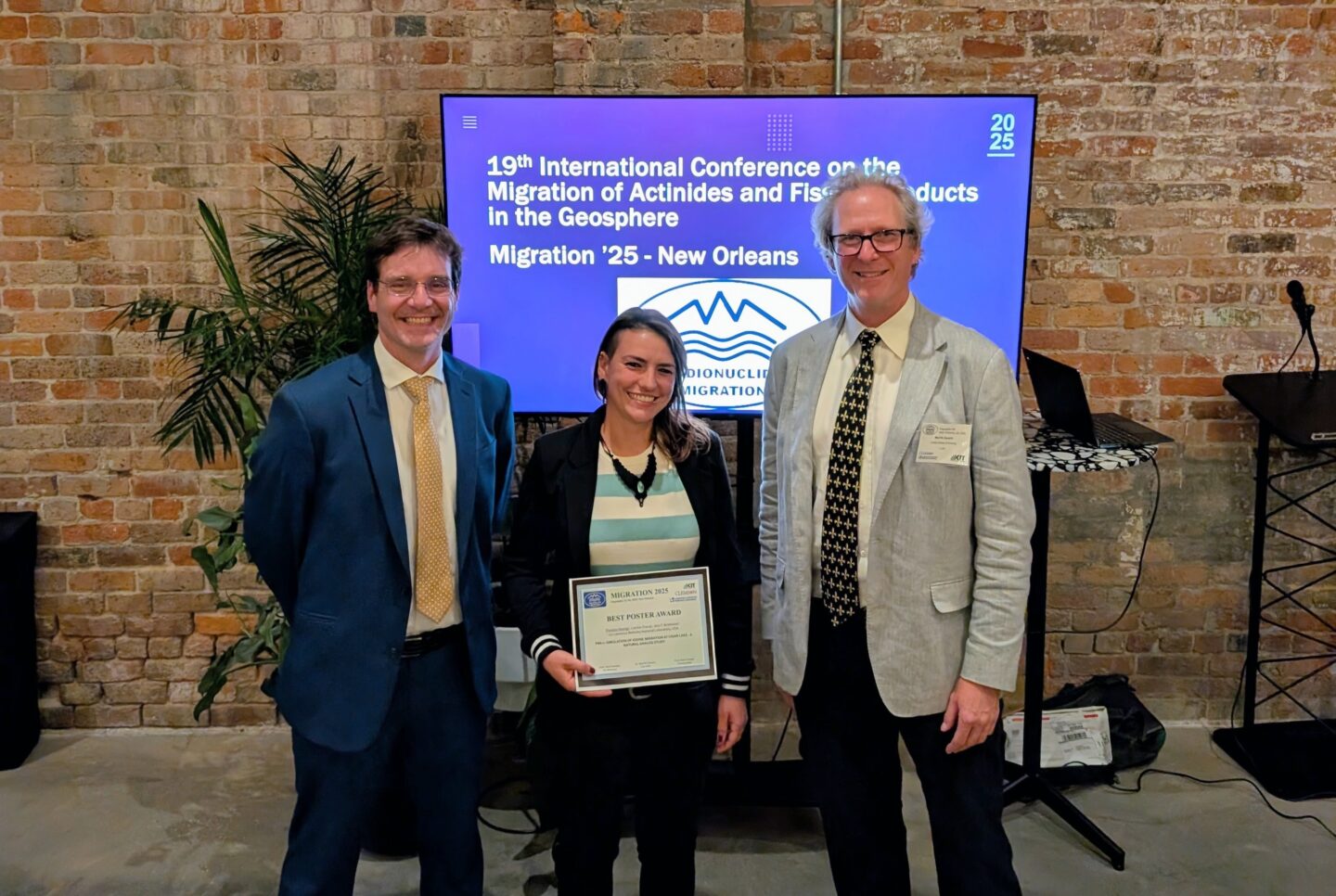
Energy Geosciences Division Postdoc Theresa Hennig has been awarded one of three Best Poster Awards at the 19th Conference on the Migration of Actinides and Fission Products in the Geosphere (Migration ’25). This conference brings together scientists from across the world to discuss how radioactive materials move and are contained within Earth’s subsurface.
Hennig studies an underground uranium mine in northern Saskatchewan, Canada called Cigar Lake. Her poster stood out for its clear structure, strong presentation, and highly relevant focus on how radioactive materials can be safely contained underground for millions of years. Cigar Lake holds some of the world’s highest uranium concentrations, kept isolated by uniquely stable geochemical conditions. Its remarkable structure serves as an analog for modern-day waste repositories. Using computer models, Hennig investigates how the movement of minerals like iodine are controlled in Cigar Lake to help scientists better understand and design safe, long-term underground waste storage systems.
Hennig received her PhD in hydrogeology from the University of Potsdam in Germany, where she also received her Bachelor’s and Master’s degrees in Geoecology. This year, she was awarded a Feodor Lynen Research Fellowship from the Alexander von Humboldt Foundation to do her postdoc in the Energy Geosciences Division at Berkeley Lab.