
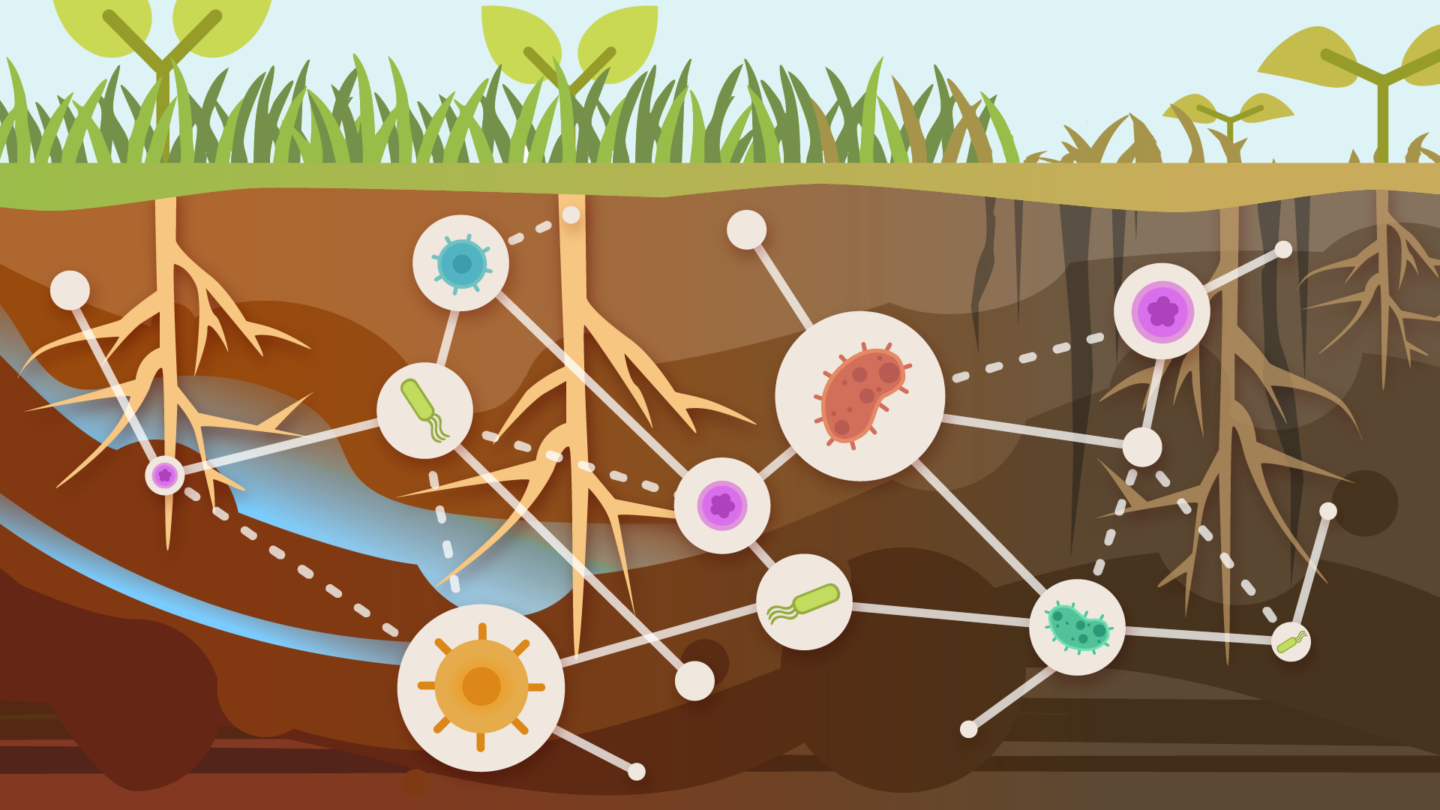
Many people take a probiotic to promote gut health, but what they’re consuming is technically called a simplified synthetic microbial community (SynCom): a curated group of microbes designed to help with a specific function. As microbes are important in many settings outside of human health, SynComs are used in numerous different ways–especially in environmental contexts, in which microbes are crucial to helping plants survive stressors like flooding, extreme temperatures, and drought.
EESA scientists found that a SynCom composed specifically of microbes from the rhizosphere–the region of soil composed of plant roots and their associated microbes–can help plants better recover from drought. Their results, recently published in Frontiers in Microbiology, demonstrate the importance of rhizosphere microbes in helping plants recover after disturbances. This could bring us one step closer to a potential future where, to facilitate the growth of more resilient plants and crops, we swap out chemical fertilizers for helpful bacteria.
Curating a microbial community
Microbes in the rhizosphere play a large role in the health of plants by helping with nutrient uptake, breaking down organic matter to increase nutrient availability, outcompeting pathogens, and producing organic molecules that help with stress tolerance.
“The rhizosphere environment is pretty complex,” explained EESA Postdoc Mingfei Chen, who led the study in Romy Chakraborty’s lab as part of the Microbial Community Analysis & Functional Evaluation in Soils Scientific Focus Area, m-CAFEs SFA. “There are thousands of different kinds of microbes in the rhizosphere. Many of them are really helpful to plants, but others not so much. This study shows that isolating and increasing the concentration of microbes that directly benefit plants can help us optimize plant stress tolerance.”
The team specifically studied a species of grass called Brachypodium distachyon, which is related to major cereal grain species like wheat, oats, and rice. In previous work, the scientists studied and isolated 15 different microbe species from the rhizosphere of young B. distachyon plants grown in the lab. The genome analysis of the microbes–DNA data that gives insights to microbial traits–showed that these microbes can help with nutrient acquisition, disease defence, and drought tolerance. They also tested the coexistence of the microbes together and observed positive interactions as the SynCom grew.
The researchers exposed the plants to three different conditions–drought, rewatered drought, and salinity, to simulate natural environmental stress and recovery. For each condition, one group of B. distachyon was treated with a SynCom, while another was left untreated, allowing the scientist to directly compare the SynCom’s effects.
Powering recovery with SynComs
After three weeks, the scientists harvested the plants to measure their “shoots,” or the above-ground part of the plant, along with root length, weight, and leaf count. For plants experiencing drought- recovery conditions, they found significant improvements in all growth traits, indicating the microbes helped with post-stress recovery.
They also found that the 15 different microbe species in the SynCom survived the stress, but the abundance of each type shifted differently for each condition. Under drought and salt stress, they found specific microbes near the root tip, the part of the root that’s actually growing, suggesting that the plants might be sending out signals to attract microbes to help with growth.
“The SynCom helped plants recover from drought more than it helped them survive the drought itself,” explained Chen. “But the plant is a very complicated system, and there’s still a lot to understand about how they interact with these microbes.”
The team hopes to investigate how SynComs might affect the drought recovery of crops like rice or wheat to understand how they could apply their findings to agriculture. With more research, microbes could serve as valuable tools to help plants and crops recover from the increasing frequency and intensity of drought stress.
The mCAFEs SFA is funded by the Biological and Environmental Research program of the Department of Energy Office of Science.