
Scientists and industry operators like Fervo Energy are developing enhanced geothermal systems (EGS) to access the constant heat deep underground, where higher temperatures at greater depths offer affordable, round-the-clock energy.
EGS reservoirs can produce microseismic events — typically of very low magnitude and rarely felt at Earth’s surface — that can help scientists better understand how rock fractures form to advance geothermal energy production.
Since July, Lawrence Berkeley National Laboratory (Berkeley Lab) geophysicists have continuously monitored tiny seismic signals nearly 7,000 feet underground — where temperatures reach 338 °F — at Fervo Energy’s Utah EGS site, Cape Station. The next warmest temperature recorded in the area is 302 °F, making the Berkeley Lab monitoring a breakthrough in detailed, long-term monitoring of geothermal reservoirs under high-temperature conditions.
“Such high-temperature measurements are critical for geothermal energy production, and as far as we know, this is the world’s longest recorded measurement at this temperature,” said Nori Nakata, a Berkeley Lab staff scientist who developed the high-temperature seismometer with Paul Cook, at the laboratory’s Geosciences Measurement Facility (GMF). “If we can advance the science needed to achieve round-the-clock monitoring of EGS operations, it will help expand EGS effectively and safely.”
Scaling enhanced geothermal systems with continuous monitoring
Heat exists almost everywhere underground, but many rocks lack the permeability needed for fluid to flow and transfer heat effectively. EGS increases that permeability, unlocking a constant domestic energy source. Since 2023, Fervo Energy’s Cape Station has served as a hub for research advancing geothermal development in southwest Utah, a region where hot subsurface conditions mirror those found throughout the geothermal-rich American West. The Houston-based Fervo Energy, a leading geothermal company and a 2018 participant in Berkeley Lab’s Cyclotron Road entrepreneurial fellowship program, plans to begin delivering the first 100 MW of what will become 500 MW of continuous geothermal power from Cape Station by 2026.
In EGS, water moves through fractures deep underground, absorbing heat that’s converted to electricity. Most of the sensors used to monitor these flow paths operate at depths less than 131 feet where temperatures are cooler, but researchers are increasingly developing technologies capable of withstanding extreme heat at greater depths, where conditions are most favorable for geothermal energy production.
As Nakata notes, “Continuous seismic recording is important to expanding EGS operations. For one, it improves what we know about how rock fractures develop. For example, with more information about microseismicity at greater depths, we can control fluid injection and circulation within the reservoir so it efficiently produces the steam that is converted to electricity.”
Continuous monitoring at lower depths also helps by providing a larger catalog of small seismic events, helping scientists better understand and manage induced seismicity. With more data, they can improve control of reservoir development and reduce the likelihood of larger events that could be felt at Earth’s surface.
Advancing reliable tools for next-generation geothermal
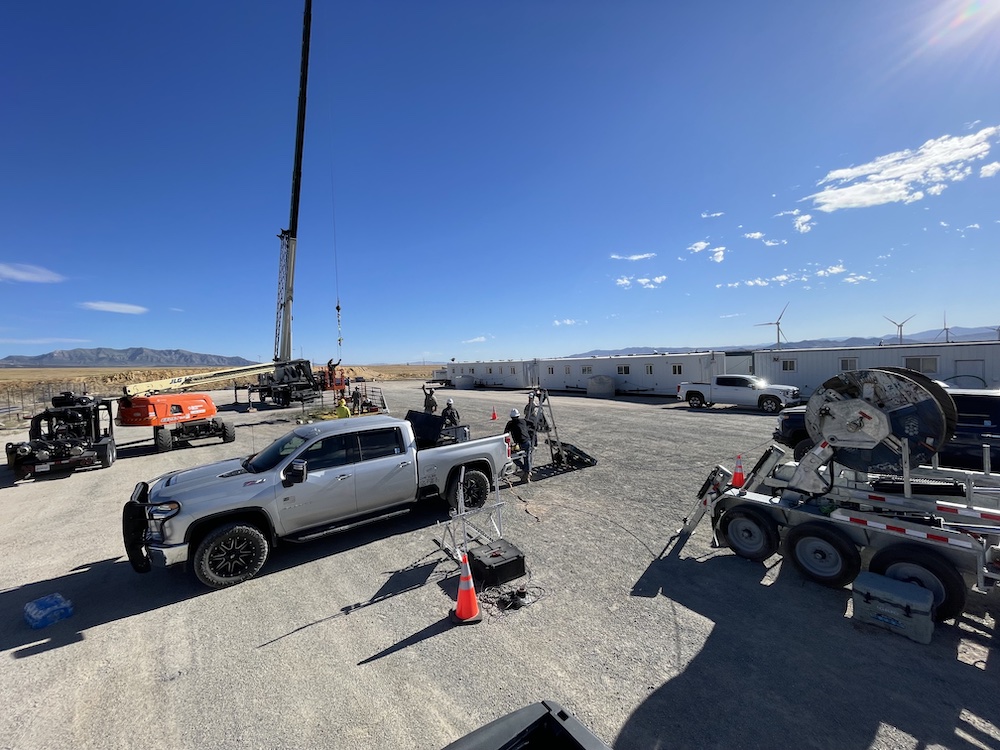
Measuring just under 10 feet long, the seismometer developed at Berkeley Lab’s GMF was deployed 6,995 feet underground on July 27 through a borehole at Cape Station. Situated beside the Department of Energy’s Frontier Observatory for Research in Geothermal Energy (FORGE), this site offers Fervo valuable data on reservoir characteristics to better manage and reduce the risk of induced seismic activity. Utah, meanwhile, is among eight states producing geothermal energy, with its first plant dating back to 1984. Fervo continues to carry out regular seismic monitoring to evaluate potential seismic risks.
“Developing sensors that can reliably operate at high temperatures is a game-changer for geothermal energy,” says Sireesh Dadi, Manager of Data Acquisition and Advanced Analytics at Fervo Energy. “We’re advancing tools for microseismic monitoring, pressure sensing, and strain sensing that help us better understand reservoir behavior in real time.”
Berkeley Lab’s GMF develops and deploys customized geoscience instruments designed to operate in harsh, remote environments for extended periods such as this seismometer, which is sealed to prevent water seepage and designed without extra components that could fail under intense heat.
Geophysicists in Berkeley Lab’s Energy Geosciences Division began studying geothermal energy at the Geysers Field nearly 50 years ago. Since then, they have led collaborations to develop, sustain, and monitor EGS, and to align research with technology and materials advances that have transformed the geothermal landscape. Recently the team has led field-scale demonstrations at sites such as Cape Station and Utah FORGE. In other projects supported by DOE, they are also testing EGS in superhot conditions elsewhere that exceed 700°F.
The team has also developed widely used software to simulate reservoir processes that may help identify promising EGS sites and track reservoir performance over time. By combining advanced modeling with sensors designed to withstand extreme underground heat, scientists are gaining critical insights into how rocks and fluids behave — knowledge essential to expanding geothermal energy. The team is also applying advanced data processing and artificial intelligence to fuse diverse datasets, uncover patterns that would otherwise remain hidden, and support better decision-making in reservoir management.
“We want to know the true conditions inside a geothermal reservoir, but that’s difficult to see directly,” says Nakata. “For EGS to become a major U.S. energy source, we need a clear understanding of rock stress, permeability, fluid pathways, and fracture growth. These factors are critical both to generate electricity and to avoid unwanted induced seismicity.”
This research is supported by the Department of Energy’s Hydrocarbons and Geothermal Energy Office.