
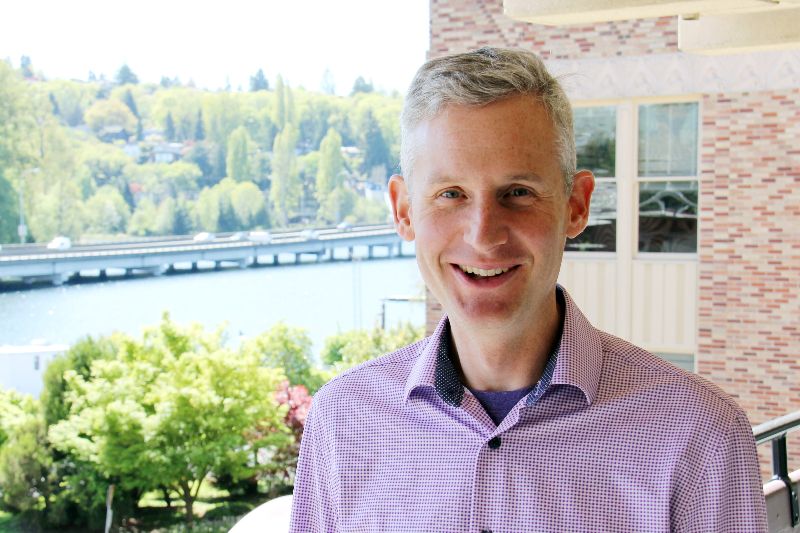
Kevin Werner, an accomplished research administrator who led one of the nation’s largest fisheries science centers, has been selected as executive director for the National Alliance for Water Innovation (NAWI), a water research program led by Berkeley Lab and housed within its Energy Geosciences Division.
Werner brings over 25 years of federal experience with the National Oceanic and Atmospheric Administration (NOAA), where in multiple science and administrator roles he worked to connect science solutions to real-world challenges in the management of water and other natural resources.
NAWI advances technologies that enable the reuse of unconventional water sources such as brackish groundwater and produced water from oil, gas, and agriculture. Since its launch in 2020 NAWI has supported research needed to dramatically lower the cost and energy of desalination and water reuse. Backed by federal support and several California water agencies, NAWI is now expanding its focus to include regional water systems planning to help secure reliable water supplies.
Werner, whose doctoral research at the University of Utah explored how science can–and cannot–inform state-level water policy and infrastructure planning, brings valuable expertise to NAWI’s next phase.
“We are thrilled to welcome Kevin Werner as the next executive director of the National Alliance for Water Innovation,” said Bill Collins, associate laboratory director of the Earth and Environmental Sciences Area at Berkeley Lab. “Kevin’s deep experience in public administration and applying science to real-world challenges makes him uniquely qualified to help NAWI advance innovations that deliver new, affordable water supplies. This is especially true as the program broadens its focus to include regional water security.”
Werner spent 25 years at NOAA, most recently leading the development of an agency-wide employee experience initiative. Prior to that he led the Northwest Fisheries Science Center in Seattle for seven years. Werner also led NOAA efforts to improve water-resource forecasting and its application, especially in the western United States.
“Kevin’s deep experience in public administration and applying science to real-world challenges makes him uniquely qualified to help NAWI advance innovations that deliver new, affordable water supplies. This is especially true as the program broadens its focus to include regional water security,” said Bill Collins, associate laboratory director of the Earth and Environmental Sciences Area at Berkeley Lab.
Over the past five years, NAWI has built a robust research portfolio of more than 80 innovative R&D projects–ranging from water-energy grid integration analysis to the development of advanced algorithms and adaptive process controls for resilient operations. It has launched 11 pilot projects to demonstrate these technologies in real-world settings; developed a 1,670-member Alliance; and partnered with over 520 industry, academic, and government stakeholders. NAWI has also produced a suite of knowledge products, including a master roadmap and sector-specific roadmaps to guide high-impact technology development. To date, NAWI researchers have published more than 100 articles in leading research journals.
Moving forward, NAWI will partner with state and regional water planners to develop tools for water supply and demand forecasting and portfolio optimization, while also leading resilience pilot projects and regional system workshops.
“I am excited to return to the water world and join the NAWI team and all their partners,” Werner said. “NAWI’s work on building water resiliency is as important as ever and I’m eager to get started. ”
NAWI is led by DOE’s Lawrence Berkeley National Laboratory in collaboration with the National Renewable Energy Laboratory, Oak Ridge National Laboratory, National Energy Technology Laboratory, and the SLAC National Accelerator Laboratory and funded by the Office of Energy Efficiency and Renewable Energy’s Industrial Technologies Office and Water Power Technologies Office of the U.S. Department of Energy, with additional support from the California Department of Water Resources and the State Water Resources Control Boards.