
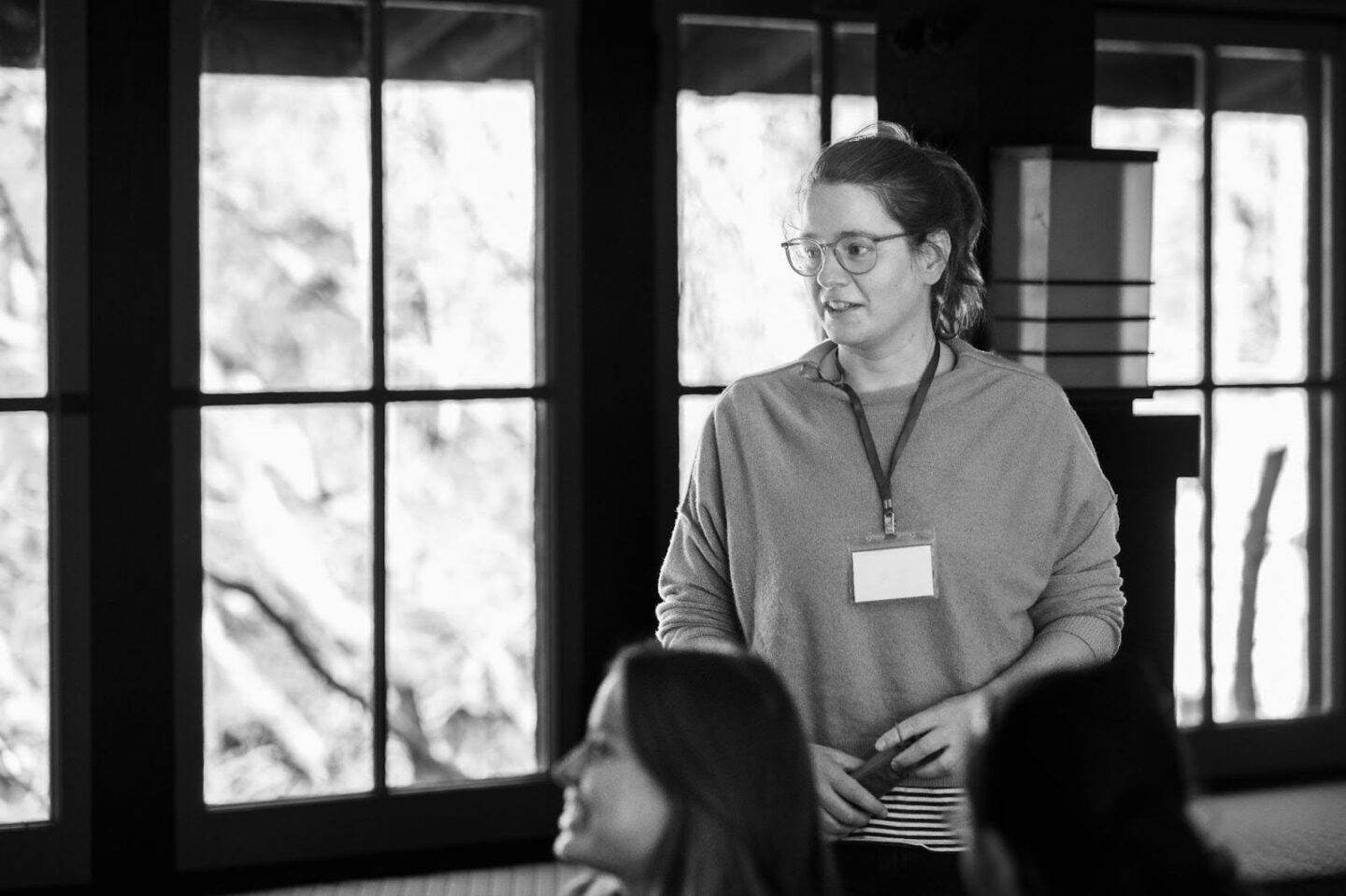
For Energy Geosciences Postdoctoral Fellow Anne Voigtländer, pursuing a science career felt unlikely. But despite having little exposure to academics from her family, Voigtländer embraced the tendencies of a scientist early on–asking never-ending questions and trying to find better, creative ways to tackle problems. It was just a matter of piecing together different experiences and trusting her gut that would lead her to pursue geomorphology–the study of physical processes that shape landscapes.
Voigtländer’s research focuses on rock stress (the force or pressure upon rock), answering the question of how, where, and why rocks break. This type of study could help identify areas vulnerable to natural hazards such as landslides or earthquakes.
From communicating research with a comic, to embracing the unknown with humor and candor, Voigtländer’s approach to science–and life–serves as an important reminder that many decisions and opportunities often lead us right where we’re supposed to be, even if it might not seem like it at the time.
The journey to geomorphology
“My early-on environment really shaped me,” said Voigtländer. “I grew up in a communicative and artistic household, constantly surrounded by a lot of people with different occupations. They weren’t scientists, but they were creative and technical, and always building, making, doing, and sharing things.”
Without an initial plan to pursue research, Voigtländer studied geography, geology, geophysics and political sciences at the University of Bonn, Germany, while working in construction and landscape gardening. During her time at university, she found interest in the sciences, but struggled in the traditional academic setting.
After completing her diploma, this steered Voigtländer out of academia. She worked in river planning and restoration, but felt that something was missing and decided to re-enroll in a part-time physics program; if only for the benefit of a regional transit ticket.
“When you learn something, you connect it to what you’re familiar with,” Voigtländer said. “While I was learning more about physics, I was looking for those fundamental principles, concepts and theories in Earth system sciences, which is how I solidified my interest in geomorphology and geomechanics.”
With renewed motivation, Voigtländer wrote her own project proposal and received a scholarship to pursue a PhD at Technical University Munich, Germany. She combined her interests of geology and physics by studying the internal stress of rocks with neutron diffraction, a technique that shoots neutron beams (similar to shooting x-ray beams) that scatter and interact to reveal the atomic structure of a rock sample. This data indicates the internal state of rocks, which is useful to understanding how they might break.
An unconventional (and successful) research presentation
While preparing a poster presentation for the 2017 European Geophysical Union annual meeting, Voigtländer was faced with presenting theoretical concepts about rock mechanics in an engaging way.
Instead of creating a traditional research poster, Voigtländer drew a comic, connecting to her early-on experiences with art and creativity. She used a chocolate bar as an analogy to explain how she studies rock fracture: the grooves on a chocolate bar concentrate stress, allowing it to break easier in these spots. Rocks all have different structures that dictate how, when, and in which way they break.
“A comic isn’t perceived as scientific–but why not?” Voigtländer questioned. “Anything that makes someone understand what you’re talking about is scientific.”
Her poster received positive attention, later turned into a publication in Earth Surface Process and Landforms, and got her invited to give a talk at the Helmholtz Center for Geosciences in Potsdam (GFZ), Germany, where she was offered an opportunity to study how stress controls the erosion of rocks, by experimentally and analytically playing with sand.
After she finished her PhD, she continued her research at the GFZ for a Postdoc, and attended a conference on progressive rock failure. Here, she met EGD Senior Scientist Ben Gilbert, who invited Voigtländer to give a talk at EESA. Voigtländer was soon after offered an opportunity for a Postdoc position to continue studying rock fracture with EGD Staff Scientist Seiji Nakagawa.
Understanding landscapes, one rock sample at a time
At EESA, Voigtländer studies fundamental mechanisms of rock fracture and deformation. This research can help us understand how stresses and earthquakes impact landscapes or infrastructure, or how energy systems like geothermal energy, which bring up heated fluid from underground to the surface, could affect surrounding rock. She can be found running rock physics experiments in the lab, collecting data about the vibrations and stress of the subsurface in the field, or discussing properties and mechanics of rocks and crystals.
Outside of the lab and away from the computer, Voigtländer contributes to efforts that build leadership and science communication skills, such as the Berkeley Lab and UC Berkeley Shining Lights fellowship, a leadership training for women and their allies in STEM in the spring semester of 2025.
“Coming to Berkeley Lab was an amazing opportunity,” Voigtländer reflected. “It’s been an adventure every step of the way.”